

Access to expanded programme on immunization (EPI) in Nigeria: A case study in Lagos State Accès au programme élargi de vaccination (PEV) au Nigéria : une étude de cas dans l'État de Lagos
Article Sidebar
Abstract Views | PDF/EPUB Downloads
0
/ 0
Main Article Content
Abstract
Objective: This study assessed access to childhood immunization among children aged 12-23 months in Lagos metropolis, Nigeria.
Methods: In a descriptive cross-sectional survey, data on vaccination coverage among 373 children aged 12-23 months residing in Lagos State, Nigeria were extracted from the Child's Immunization card. Their mothers/caregivers were interviewed regarding vaccination practices, missed or rescheduled appointments, and factors influencing access to immunization services.
Results: Majority (75.9 %) of the children were fully vaccinated, with more than 97 % of the children completing their immunizations with BCG, OPV0, OPV1, OPV2, OPV3 and Penta 1, and drop-out rates were highest for Penta2 (18.5 %), Penta 3 (22.3 %), measles (24.1 %) and yellow fever (24.1 %). All respondents immunized their children at least thrice before their first birthday. Age (p = 0.0119), income (p < 0.001), religion, and marital status (p = 0.0323) of mother/caregiver of the children and sex of the children were significant to immunization practice (p = 0.0017). Reported vaccines availability was significantly associated with maternal/caregiver's age (p < 0.001), marital status (p = 0.0001), educational qualification (p = 0.0094) and income (p = 0.0001) of the mothers/caregivers. None of the independent variables was significantly associated with the need to reschedule the vaccination appointment date (p > 0.05).
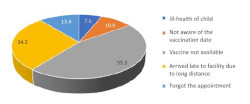
Conclusion: Child immunization coverage in the studied area was below the recommended target with a high dropout rate. A large proportion of respondents rescheduled vaccination appointments mainly due to the unavailability of vaccines and late arrival at vaccination centres. These findings underscore the need to improve vaccine availability, establish more vaccination posts in underserved communities to reduce the long distances aregivers travel to access immunization services, as well as educational interventions to emphasize the importance of completing entire immunizationschedule.
Résumé
Objectif : Cette étude a évalué l'accès à la vaccination infantile chez les enfants âgés de 12 à 23 mois dans la métropole de Lagos, au Nigéria.
Méthodes : Dans le cadre d'une enquête descriptive transversale, les données relatives à la couverture vaccinale de 373 enfants âgés de 12 à 23 mois résidant dans l'État de Lagos, au Nigéria, ont été extraites de leur carnet de vaccination. Leurs mères ou personnes en charge ont été interrogées sur les pratiques de vaccination, les rendez-vous manqués ou reportés et les facteurs influençant l'accès aux services de vaccination.
Résultats : La majorité des enfants (75,9 %) étaient entièrement vaccinés, avec plus de 97 % d'entre eux ayant reçu toutes les doses de BCG, OPV0, OPV1, OPV2, OPV3 et Penta1. Les taux d'abandon les plus élevés concernaient Penta2 (18,5 %), Penta3 (22,3 %), la rougeole (24,1 %) et la fièvre jaune (24,1 %). Tous les répondants ont fait vacciner leurs enfants au moins trois fois avant leur premier anniversaire. L'âge (p = 0,0119), le revenu (p < 0,001), la religion et la situation matrimoniale (p = 0,0323) de la mère ou de la personne s'occupant des enfants, ainsi que le sexe des enfants, ont eu une influence significative sur les pratiques de vaccination (p = 0,0017). La disponibilité déclarée des vaccins était significativement associée à l'âge ( p < 0,001), à l'état civil (p = 0,0001), au niveau d'études (p = 0,0094) et au revenu (p = 0,0001) de la mère/personne s'occupant des enfants. Aucune des variables indépendantes n'était significativement associée à la nécessité de reporter la date du rendez-vous de vaccination (p > 0,05).
Conclusion : La couverture vaccinale infantile dans la zone étudiée était inférieure à l'objectif recommandé, avec un taux d'abandon élevé. Une grande partie des répondants ont reporté leurs rendez-vous de vaccination, principalement en raison de l'indisponibilité des vaccins et de l'arrivée tardive aux centres de vaccination. Ces résultats soulignent la nécessité d'améliorer l'accès aux vaccins, de créer davantage de postes de vaccination dans les communautés mal desservies afin de réduire les longs trajets que doivent parcourir les personnes s'occupant d'enfants pour accéder aux services de vaccination, ainsi que de mener des actions de sensibilisation pour souligner l'importance de suivre l'intégralité du calendrier vaccinal.
Downloads
Article Details
Issue
Section

This work is licensed under a Creative Commons Attribution-NonCommercial-NoDerivatives 4.0 International License.
How to Cite
Share
References
1.World Health Organization. Immunization Coverage (2021). https://www.who.int/news-room/fact- sheets/detail/immunization-coverage. Accessed 16th April 2022 World Health Organization.
2.World Health Organization (2015). World health statistics 2015. Geneva.
3.Dimitrova A, Carrasco-Escobar G, Richardson R, Benmarhnia T (2023). Essential childhood immunization in 43 low- and middle-income countries: Analysis of spatial trends and socioeconomic inequalities in vaccine coverage. PLoS Medicine 20(1):e1004166. doi: et al1371/journal.pmed.1004166. PMID: 36649359; PMCID: PMC9888726.
4. National Population Commission (NPC) [Nigeria] (2019). ICF. Nigeria demographic and health survey 2018. Abuja (Nigeria) and Rockville (MD): NPC and ICF; 2019. Available from: https://www.dhsprogram.com/pubs/pdf/FR359/FR359.pdf Accessed August 2, 2022
5.TDHS. Final Report (2016). Ministry of Health, Community Development, Gender, Elderly and Children Dar Es Salaam. Ministry of Health Zanzibar. National Bureau of Statistics Dar Es Salaam. Tanzania Demographic and Health Survey and Malaria Indicator Survey; 2016
6. Kenya National Bureau of Statistics (KNBS) (2015). Ministry of Health (MOH), National AIDS Control Council (NACC), Kenya Medical Research Institute (KEMRI), National Council for Population and Development (NCPD), ICF International. Kenya demographic and health survey 2014.
7. Nairobi (Kenya): KNBS and ICF International. Federal Ministry of Health (Nigeria) (1995). National immunization policy and standard practice. Abuja: Federal Ministry of Health; p. 16 p.
8.World Health Organization (2005). WHO vaccine preventable diseases monitoring system. 2005 global summary. Immunization profile-Nigeria. Geneva: World Health Organization; 2005. p. 333 http://www.who.int/vaccines/globalsummary/immunization/countryprofileresult.cfm, accessed on 15, January 2024)
9. Shetty VU, Chaudhuri P, Sabella C (2019). Rationale for the Immunization Schedule: Why Is It the Way It Is? Paediatric Reviews 40(1):26-36. doi: 10.1542/pir.2018-0033. PMID: 30600276
10.Dawria A, Mohealdin A, Yousof O, Hussein AM (2017). Assessment, Monitoring of an Expanded Program on Immunization's Activities in Northern Nigeria States. Journal of Virology and Mycology 17(1):1-4.
11.Obasohan PE, Anosike BU, Etsunyakpa MB (2015). Determinants of full immunization coverage and reasons for its failure for children in Bida Emirate Area, Niger State, Nigeria. Merit Research Journal of Medicine and Medical Science 3 (10). Pp. 476 -483.
12. Brown VB, Oluwatosin A, Ogundeji MO (2015). Experiences, Perceptions and Preferences of Mothers Towards Childhood Immunization Reminder/Recall in Ibadan, Nigeria: A Cross Sectional Study. Pan African Medical Journal 20:243 doi:10.11604/pamj.2015.20.243.5576
13. Basheer SA, Somrongthong R, Viwattanakulvanid P, Ku.mar R (2018). Factors Influencing Immunization Coverage Among Children Under 2years of Age in Rural Local Government Areas in Kebbi State, Nigeria. Pakistan Journal of Public Health 8:206- 212.
14.Umoke CI, Umoke MJ, Nwalieji CA, Igwe F, O Umoke UG, Onwe RN, et al (2021). Investigating Factors Associated with Immunization Incompletion of Children Under Five in Ebonyi State, Southeast Nigeria: Implication for Policy Dialogue. Global Pediatric Health 8:2333794X211022680. doi:10.1177/2333794X211022680.
15.Akwataghibe NN, Ogunsola EA, Broerse JEW, Popoola AO, Agbo AI, Dieleman MA (2019). Exploring Factors Influencing Immunization Utilization in Nigeria-A Mixed Methods Study. Frontier Public Health 7(392). doi:10.3389/fpubh.2019.00392.
16.Oladokun RE, Lawoyin TO, Adedokun BO (2009). Immunization status and its determinants among children of female traders in Ibadan, South-Western Nigeria. African Journal of Medicine and Medical Science 38:9-15.
17.Abdulwahab A, Anyene B, McArthur-Lloyd A (2014). Overlooking Routine Immunization in Northern Nigeria. The Lancet Global Health. 2(6):e318.
18.Abad N, Uba BV, Patel P, Barau DN, Ugochukwu O, Aliyu N (2021). A rapid qualitative assessment of barriers associated with demand and uptake of health facility-based childhood immunizations and recommendations to improve immunization service delivery in Sokoto State, Northwest Nigeria, 2017. Pan African Medical Journal 40(Suppl 1):10. doi: 10.11604/pamj.supp.2021.40.1.23793.
19.Gidado S, Nguku P, Biya O, Waziri N, Mohammed A, Nsubuga P, et al (2014). Determinants of Routine Immunization Coverage in Bungudu, Zamfara state, northern Nigeria. The Pan African Medical Journal 18(1):9.
20.Legesse E, Dechasa W (2015). An Assessment of Child Immunization Coverage and Its Determinants in Sinana District, Southeast Ethiopia. BMC Pediatrics. 15(1):31. doi: 10.1186/s12887-015-0345-4.
21.Kitamura T, Komada K, Xeuatvongsa A, Hachiya M (2013). Factors affecting childhood immunization in Lao People's Democratic Republic: a cross- ectional study from nationwide, population-based, multistage cluster sampling. Bioscience Trends 7(4):178-185.
22. Adedokun S, Uthman O, Adekanmbi V, Wiysonge C (2017). Incomplete childhood immunization in Nigeria: a multilevel analysis of individual and contextual factors. BMC Public Health. 17(1):236.
23. Statista (2022). Number of people living in Lagos, Nigeria, from 2000 to 2035 https://www.statista.com/statistics/1308467/population-of-lagos-nigeria/
24. HEFAMAA (2017). Lagos and Equity Healthcare Services. https://lagosstate.gov.ng/blog/2017/07/05/lagos-and-equitable-healthcare-services/ Accessed August 4, 2022, Healthcare Facilities Monitoring and Accreditation Agency
25. WHO and UNICEF (2022). estimates of immunization coverage: 2022 revision available at https://data.unicef.org/wp-content/uploads/cp/immunisation/nga.pdf Accessed January 14, 2024
26. Eze P,I Agu UJ, Aniebo CL, Agu SA, Lawani LO, Acharya Y (2011). Factors associated with incomplete immunization in children aged 12-23 months at subnational level, Nigeria: a cross-sectional study. BMJ Open 11:1-11.
27. Adedire EB, Ajayi I, Fawole OI, Ajumobi O, Kasasa S, Wasswa P, et al (2016). Immunization coverage and its determinants among children aged 12-23 months in Atakumosa-west district, Osun State Nigeria: a cross-sectional study. BMC Public Health. 16:1-8
28. Kondo Kunieda M, Manzo ML, Shibanuma A, Jimba M (2021). Rapidly modifiable factors associated with full vaccination status among children in Niamey, Niger: A cross-sectional, random cluster household survey. PLoS ONE. 16(3):1-12.
29. Baguune B, Ndago JA, Adokiya MN (2017). Immunization dropout rate and data quality among children 12-23 months of age in Ghana. Arch Public Health 75:18
30. Oleribe O, Kumar V, Awosika-Olumo A, Taylor- Robinson SD (2017). Individual and socioeconomic factors associated with childhood immunization coverage in Nigeria. Pan African Medical Journal 26:220.
31. Danis K, Georgakopoulou T, Stavrou T, Laggas D, Panagiotopoulos T (2010). Socioeconomic factors play a more important role in childhood vaccination coverage than parental perceptions: a cross- sectional study in Greece. Vaccine 28(7):1861-1869.
32. Fatiregun AA, Okoro AO: (2012). Maternaldeterminants of complete child immunization among children aged 12-23 months in a southern district of Nigeria. Vaccine 30(4):730-736.
33. Mavundza EJ, Cooper S, Wiysonge CS (2023). A Systematic Review of Factors That Influence Parents' Views and Practices around Routine Childhood Vaccination in Africa: A Qualitative Evidence Synthesis. Vaccines (Basel). 11(3):563. doi: 10.3390/vaccines11030563.
34. Salako J, Bakare D, Uchendu OC, Bakare AA, Graham H, Falade AG (2024). Factors associated with immunization status among children aged 12- 59 months in Lagelu Local Government Area, Ibadan: a cross-sectional study. Pan African Medical Journal 47:35. doi: 10.11604/pamj.2024.47.35.37013.
35. Adenike OB, Adejumoke J, Olufunmi O, Ridwan O (2017). Maternal characteristics and immunization status of children in North Central of Nigeria. Pan African Medical Journal 26:159.
36. Umeokonkwo AA, Ezeonu TC, Agu AP, Umeokonkwo CD (2022). Timeliness of Vaccination among Children Attending Immunization Clinic at a Tertiary Hospital in South-East Nigeria. Nigerian Medical Journal 62(4):153-161. doi: 10.60787/NMJ-62-4-29.
37. Oyo-Ita A, Wiysonge CS, Oringanje C, Nwachukwu CE, Oduwole O, Meremikwu MM (2016). Interventions for improving coverage of child immunization in low- and middle-income countries. Cochrane Database Systematic Reviews 7(7):CD008145.
38. Luman ET, Barker LE, Shaw KK, McCauley MM, Buehler JW, Pickering LK (2005). Timeliness of childhood vaccinations in the United States: days under vaccinated and number of vaccines delayed. JAMA 293(10):1204-11.