

Pharmacological Effects of Cyperus articulatus L. Rhizome Essential Oil against Cough, Inflammation, and Nociception in Mouse Models Effets pharmacologiques de l'huile essentielle de rhizome de <i>Cyperus articulatus</i> L. contre la toux, l'inflammation et la nociception chez des modèles murins
Article Sidebar
Abstract Views | PDF/EPUB Downloads
55
/ 8
/ 7
Main Article Content
Abstract
Background: Cyperus articulatus L. rhizomes are widely used in traditional medicine for different ailments. different studies have reported the pharmacological properties of C. articulatus essential oil.
Objectives: To explore the antitussive, anti-inflammatory, and antinociceptive potentials of C. articulatus essential oil.
Methods: C. articulatus essential oil (CAEO) was obtained by hydro-distillation, and Gas Chromatography-Mass Spectrometry was used to analyze its chemical composition. Male and female mice (20-27 g) were used in this study. Oral toxicity test and anti-tussive screening were conducted, nociception and inflammation were induced. The antitussive, anti-inflammatory, anti-nociceptive activities and the central analgesic activity of the plant were evaluated.
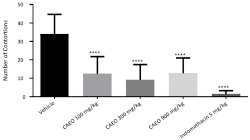
Results: α-pinene (7.7 %), (-)-β-pinene (7.5 %), neoisolongifolene (6.9%), isopinocarveol (6.7 %), α- copaene (5.2%), (-)-Myrtenol (4.8 %), isolongifolen-5-one (4.1 %), and mustakone (3.8 %) were present in CAEO. The essential oil displayed antibacterial activity against Staphylococcus aureus (minimum inhibitory concentration: 0.89 mg/mL). CAEO significantly (p < 0.01) suppressed cough bouts and inhibited abdominal pain at the doses administered. Furthermore, the essential oil reduced pain severity at various phases and exhibited central antinociceptive activity after its oral administration.
Conclusion: C. articulatus essential oil possesses bioactive compounds and demonstrates antitussive, antiinflammatory, and antinociceptive activity. It can be further developed as a remedy against cough, inflammation, and pain.
Résumé
Contexte : Les rhizomes de Cyperus articulatus L. sont largement utilisés en médecine traditionnelle pour traiter diverses affections. Plusieurs études ont fait état des propriétés pharmacologiques de l'huile essentielle de C. articulatus.
Objectifs : Explorer les potentiels antitussifs, anti-inflammatoires et antinociceptifs de l'huile essentielle de C. articulatus.
Méthodes : L'huile essentielle de C. articulatus (HECA) a été obtenue par hydrodistillation, et sa composition chimique a été analysée par chromatographie en phase gazeuse couplée à la spectrométrie de masse. Des souris mâles et femelles (20-27 g) ont été utilisées dans cette étude. Un test de toxicité par voie orale et un criblage antitussif ont été réalisés, et une nociception et une inflammation ont été induites. Les activités antitussive, antiinflammatoire, antinociceptive, ainsi que l'activité analgésique centrale de la plante ont été évaluées.
Résultats : L'huile essentielle HECA contenait de l’α-pinène (7,7 %), du (-)-β-pinène (7,5 %), du néoisolongifolène (6,9 %), de l'isopinocarvéol (6,7 %), de l’α-copaène (5,2 %), du (-)-myrténol (4,8 %), de l'isolongifolène-5-one (4,1 %) et de la mustakone (3,8 %). Cette huile essentielle a démontré une activité antibactérienne contre Staphylococcus aureus (concentration minimale inhibitrice : 0,89 mg/mL). Aux doses administrées, la HECA a significativement (p < 0,01) atténué les quintes de toux et inhibé les douleurs abdominales. En outre, l'huile essentielle a réduit l'intensité de la douleur à différentes phases et a exhibé une activité antinociceptive centrale après son administration par voie orale.
Conclusion : L'huile essentielle de C. articulatus contient des composés bioactifs et présente des propriétés antitussives, anti-inflammatoires et antinociceptives. Elle pourrait faire l'objet de développements supplémentaires en tant que remède contre la toux, l'inflammation et la douleur.
Downloads
Article Details
Issue
Section

This work is licensed under a Creative Commons Attribution-NonCommercial-NoDerivatives 4.0 International License.
How to Cite
Share
References
1. Cyperus articulatus Linn. [family CYPERACEAE] on JSTOR. (n.d.). Retrieved February 15, 2023, from https://plants.jstor.org/stable/10.5555/al.ap.upwta.1_1244.
2. Silva ÉB, Barata LE, Arévalo MR, Vieira LQ, Castro W, Ruiz AL, Torre AD, Castro KC, Sartoratto A, Baratto LC, de Santana MB. (2021). Chemical Composition and Antiproliferative Activity of the Ethanolic Extract of Cyperus articulatus L. (Cyperaceae). Plants (Basel, Switzerland), 10(10):2 084. https://doi.org/10.3390/plants10102084
3. Taylor L. (1996). Tropical Plant Database. Raintree Nutrition, Incorporated.
4. The Plant List. Cyperus articulatus L. (n.d.). The Plant List. Retrieved from http://www.theplantlist.org/tpl1.1/record/kew235733
5. Cyperus articulatus Jointed flatsedge, Priprioca, Piripiri PFAF Plant Database. (n.d.). Retrieved March 24, 2023, from https://pfaf.org/user/Plant.aspx?LatinName=Cyperus+articulatus
6. Herrera-Calderon O, Santiváñez-Acosta R, PariOlarte B, Enciso-Roca E, Montes VM, Acevedo JL. (2018). Anticonvulsant effect of ethanolic extract of Cyperus articulatus L. leaves on pentylenetetrazol induced seizure in mice. Journal of Traditional and Complementary Medicine, 8(1): 95-99.
7. Swain A, Santhoshkannada AN, Prabakaran D, Choudhir G, Puttaswamy H. (2021). Phytochemical and pharmacological exploration of Cyperus articulatus as a potential source of nutraceuticals and drug ingredients. Indian Journal of Pharmaceutical Education and Research, 55(4): 1084-1095.
8. Nogueira ML, Lima EJ, Adrião AA, Fontes SS, Silva VR, Santos LD, Soares MB, Dias RB, Rocha CA, Costa EV, Silva FM. (2020). Cyperus articulatus L.(Cyperaceae) rhizome essential oil causes cell cycle arrest in the G2/M phase and cell death in HepG2 cells and inhibits the development of tumors in a xenograft model. Molecules, 25(11): 2687.
9. Yeshi K, Wangchuk P. (2023). Bush medicinal plants of the Australian wet tropics and their biodiscovery potential. In: Bioprospecting of Tropical Medicinal Plants (pp. 357-379). Cham: Springer Nature Switzerland.
10. Ferreira JC, Pereira AM, Aranha ES, Moraes CC, de Souza Ferreira B, Sartoratto A, Goes GR, Moraes TM, Moraes WP. (2025). Cyperus articulatus: Antiinflammatory and antinociceptive activity of a medicinal plant from the Amazon. Journal of Ethnopharmacology, 337: 118947.
11. Swain A, Duraivadivel P, Choudhir G, Hariprasad P. (2022). Chemical composition and antimicrobial properties of the rhizome essential oil of Cyperus articulatus L. grown in Karnataka, India. Indian Journal of Natural Products and Resources (IJNPR)[Formerly Natural Product Radiance (NPR)] 13(1):112-118.
12. Machado IR, Mendes KR, Arévalo MR, Kasper AA, Castro KC, de Giorge Cerqueira H, Silva AS, Barata LE. (2020). Medical, therapeutic and pharmaceutical use of Cyperus articulatus L.: uma Revisão. Biodiversidade Brasileira, 10(3): 11-23.
13. Schön T, Werngren J, Machado D, Borroni E, Wijkander M, Lina G, Mouton J, Matuschek E, Kahlmeter G, Giske C, Santin M. (2020). Antimi c robi a l sus c eptibi l it y te sting of Mycobacterium tuberculosis complex isolates-the EUCAST broth microdilution reference method forMIC determination. Clinical Microbiology and Infection, 26(11): 1488-1492.
14. da Silva IC, dos Santos WL, Leal IC, Zoghbi MD, Feirhmann AC, Cabral VF, Macedo EN, Cardozo-Filho L. (2014). Extraction of essential oil from Cyperus articulatus L. var. articulatus (priprioca) with pressurized CO2. The Journal of Supercritical Fluids, 88: 134-141.
15. Percie du Sert N, Hurst V, Ahluwalia A, Alam S, Avey MT, Baker M, Browne WJ, Clark A, Cuthill IC, Dirnagl U, Emerson M. (2020). The ARRIVE guidelines 2.0: Updated guidelines for reporting animal research. Journal of Cerebral Blood Flow & Metabolism, 40(9): 1769-1777.
16. OECD Test No. 425. (2022). Acute Oral Toxicity: Up-and-Down Procedure. https://doi.org/https://doi.org/10.1787/9789264071049-en
17. Cruz LF, de Figueiredo GF, Pedro LP, Amorin YM, Andrade JT, Passos TF, Rodrigues FF, Souza IL, Gonçalves TP, dos Santos Lima LA, Ferreira JM. (2020). Umbelliferone (7-hydroxycoumarin): A nontoxic antidiarrheal and antiulcerogenic coumarin. Biomedicine & Pharmacotherapy, 129: 110432.
18. Adejayan AA, Ozolua RI, Uwaya DO, Eze GI, Ezike AC. (2019). Evaluation of the anti-asthmatic and antitussive potentials of methanol leaf extract of Napoleona vogelii in rodents. Biomedicine & Pharmacotherapy, 109: 120-126.
19. Conegundes JL, da Silva JM, de Freitas Mendes R, Fernandes MF, Pinto ND, de Almeida MA, Dib PR, de Oliveira Andrade R, Rodrigues MN, Castañon MC, Macedo GC. (2021). Anti-inflammatory and antinociceptive activity of Siparuna guianensis Aublet, an amazonian plant traditionally used by indigenous communities. Journal of Ethnopharmacology, 265: 113344.
20. Mirghazanfari SM, Aldein AH, Parviz M, Ahmadi BZ.(2019). Evaluation of Ficus carica Linn fruit extracts on formalin induced pain in the male rat paw. Annals of Military and Health Sciences Research, 17(3): 1-6.
21. Deng J, Han J, Chen J, Zhang Y, Huang Q, Wang Y, Qi X, Liu Z, Leung EL, Wang D, Feng Q (2021). Comparison of analgesic activities of aconitine in different mice pain models. PLoS One, 16(4): e0249276.
22. Kavaz D, Idris M, Onyebuchi C (2019). Physiochemical characterization, antioxidative, anticancer cells proliferation and food pathogens antibacterial activity of chitosan nanoparticles loaded with Cyperus articulatus rhizome essential oils. International journal of Biological Macromolecules, 123: 837-845.
23. Tongnuanchan P, Benjakul S. (2014). Essential oils: extraction, bioactivities, and their uses for food preservation. Journal of Food Science, 79(7): R1231- R1249.
24. Martínez-Pabón MC, Ortega-Cuadros M. (2020). Thymol, menthol and eucalyptol as agents for microbiological control in the oral cavity: A scoping review. Revista Colombiana de Ciencias QuímicoFarmacéuticas, 49(1): 44-69.
25. Eldahshan OA, Barakat A, Efferth T. (2018). The prophylactic effect of a Eugenia aquea extract against oxidative stress and inflammation associated with the development of arthritis in an adjuvantinduced arthritis rat model. Food & Function, 9(12): 6643-6651.
26. Boukhatem MN, Darwish NH, Sudha T, Bahlouli S, Kellou D, Benelmouffok AB, Chader H, Rajabi M, Benali Y, Mousa SA. (2020). In vitro antifungal and topical anti-inflammatory properties of essential oil from wild-growing thymus vulgaris (Lamiaceae) used for medicinal purposes in algeria: A new source of carvacrol. Scientia Pharmaceutica, 88(3): 33.
27. Yuan Z, Dai Y, Ouyang P, Rehman T, Hussain S, Zhang T, Yin Z, Fu H, Lin J, He C, Lv C. (2020). Thymol inhibits biofilm formation, eliminates pre-existing biofilms, and enhances clearance of methicillin-resistant Staphylococcus aureus (MRSA) in a mouse peritoneal implant infection model. Microorganisms, 8(1): 99.
28. Swain A, Duraivadivel P, Choudhir G, Hariprasad P (2022). Chemical composition and antimicrobial properties of the rhizome essential oil of Cyperus articulatus L. grown in Karnataka, India. Indian Journal of Natural Products and Resources (IJNPR)[Formerly Natural Product Radiance (NPR)]. 2022 Dec 5;13(1):112-8.
29. Amerikova M, Pencheva El-Tibi I, Maslarska V, Bozhanov S, Tachkov K (2019). Antimicrobial activity, mechanism of action, and methods for stabilisation of defensins as new therapeutic agents. Biotechnology & Biotechnological Equipment, 33(1): 671-682.
30. Angane M, Swift S, Huang K, Butts CA, Quek SY. (2022). Essential oils and their major components: an updated review on antimicrobial activities, mechanism of action and their potential application in the food industry. Foods, 11(3): 464.
31. Reyes-Jurado F, Navarro-Cruz AR, Ochoa-Velasco CE, Palou E, López-Malo A, Ávila-Sosa R. (2020). Essential oils in vapor phase as alternative antimicrobials: A review. Critical Reviews in Food Science and Nutrition, 60(10): 1641-1650.
32. Li H, Zhao L, Dai Q, Mo H, Liu Z, Pu H, Zhu X, Yao L, Xu D, Hu L. (2023). Blended cumin/Zanthoxylum essential oil improve the antibacterial, freshkeeping performance and flavor of chilled fresh mutton.Meat Science, 200: 109173.
33. Swain A, Choudhir G, Prabakaran D, Hariprasad P. (2023). Molecular docking, dynamics simulation and pharmacokinetic studies of Cyperus articulatus essential oil metabolites as inhibitors of Staphylococcus aureus. Journal of Biomolecular Structure and Dynamics, 41(19): 9245-9255.
34. Baky MH, Farag MA, Rasheed DM. (2020). Metabolome-based analysis of herbal cough preparations via headspace solid-phase microextraction GC/MS and multivariate data analyses: A prospect for its essential oil equivalency. ACS Omega, 5(48): 31370-31380.
35. Abidi S, Imam S, Tasleem F, Zehra Rizvi SR, Salman S, Gilani U, Mahmood ZA. (2021). Formulation and evaluation of natural antitussive cough syrups. Pakistan Journal of Pharmaceutical Sciences, 34(5).
36. Birring S, de Blasio F, Dicpinigaitis PV, Fontana G, Lnata L, Page C, Saibene F, Zanasi A. (2019). Antitussive therapy: A role for levodropropizine. Pulmonary Pharmacology & Therapeutics, 56: 79- 85.
37. Singh N, Driessen AK, McGovern AE, Moe AA, Farrell MJ, Mazzone SB. (2020). Peripheral and central mechanisms of cough hypersensitivity. Journal of Thoracic Disease, 12(9): 5179.
38. Matsuda M, Huh Y, Ji RR. (2019). Roles of inflammation, neurogenic inflammation, and neuroinflammation in pain. Journal of Anesthesia, 33(1): 131-139.
39. Yaksh TL, Wallace MS. (2011). Opioids, analgesia, and pain management. Goodman and Gilman's the pharmacological basis of therapeutics, 481-526.
40. Niu X, Wang X, Niu B, Meng Y, He H, Wang Y, Li G. (2021). Costunolide loaded in pH-responsive mesoporous silica nanoparticles for increased stability and an enhanced anti-fibrotic effect. Pharmaceuticals, 14(10): 951.
41. Mogil JS. (2009). Animal models of pain: progress and challenges. Nature Reviews Neuroscience, 10(4): 283-294.
42. Aalidaeijavadi Z, Khodagholi F, Haghparast A. (2026). Potential effects of cannabidiol on formalininduced inflammatory pain in morphine-dependent rats. Journal of Psychiatric Research, 197: 17-25
43. Lisa NP, Millis RM. (2022). Epigenetics and Pain: New Insights to an Old Problem. Cureus, 14(9).
44. Rodriguez-Gaztelumendi A, Spahn V, Labuz D, Machelska H, Stein C. (2018). Analgesic effects of a novel pH-dependent μ-opioid receptor agonist in models of neuropathic and abdominal pain. Pain, 159(11): 2277-2284.
45. Wang L, Tobe J, Au E, Tran C, Jomy J, Oparin Y, Couban RJ, Paul J. (2022). Selective serotonin reuptake inhibitors and serotonin-norepinephrine reuptake inhibitors as adjuncts for postoperative pain management: systematic review and meta-analysis of randomised controlled trials. British Journal of Anaesthesia, 128(1): 118-134.
46. Liu YJ, Li YL, Fang ZH, Liao HL, Zhang YY, Lin J, Liu F, Shen JF. (2022). NMDARs mediate peripheral and central sensitization contributing to chronic orofacial pain. Frontiers in Cellular Neuroscience, 16: 999509.
47. Sivakumar D, Ramli R. (2022). GABAergic signalling in modulation of dental pain. European Journal of Pharmacology, 924: 174958.
48. Chen R, Coppes M, Urman RD. (2021). Receptor and molecular targets for the development of novel opioid and non-opioid analgesic therapies. Pain Physician, 24(2): 153.