
Antifungal Activity and Time-Kill Kinetics of Griseofulvin Nanoparticles Generated by Antisolvent Precipitation Activité antifongique et cinétique antifongique des nanoparticules de griséofulvine généréespar précipitation antisolvant
Article Sidebar
Abstract Views | PDF/EPUB Downloads
112
/ 13
/ 9
Main Article Content
Abstract
Background: Griseofulvin is a fungistatic agent used in the treatment of dermatophytic infections of the scalp, hair and nails of both man and animals.
Objective: This study aimed to assess the antifungal activity and time-kill kinetics of griseofulvin nanoparticles generated by antisolvent precipitation.
Methods: The activities of griseofulvin powder and its nanoparticles generated by antisolvent precipitation against three Dermatophytes - Trichophyton rubrum, Trichophyton tonsurans and Epidermophyton floccosum were determined using standard microbiological techniques. The time-kill patterns of the two forms of the drug were also studied.
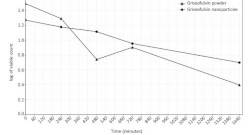
Results: The griseofulvin nanoparticles produced wider zones of inhibitions against the test organisms when compared with the pure griseofulvin powder, and the susceptibility of the test organisms to the nanoparticles was found to be in the order: Trichophyton tonsurans > Trichophyton rubrum > Epidermophyton floccosum. Minimum inhibitory concentration values of 1.56 mg/mL (Trichophyton tonsurans), 6.25 mg/mL (Trichophyton rubrum) and 1.56 mg/mL (Epidermophyton floccosum) were obtained for both the griseofulvin powder and its nanoparticles. The time-kill studies showed similar reduction in viable cell count for both the griseofulvin powder and its nanoparticles.
Conclusion: The test organisms are slightly more susceptible to the nanoparticles than the unprocessed drug, and the nanoparticles exhibit faster onset of kill. However, the extents of antifungal action of the two forms of the drug are similar.
Résumé
Contexte : La griséofulvine est un agent fongistatique utilisé dans le traitement des infections dermatophytiques du cuir chevelu, des cheveux et des ongles chez l'homme et l'animal.
Objectif : Cette étude visait à évaluer l'activité antifongique et la cinétique de destruction des nanoparticules de griséofulvine générées par précipitation antisolvant.
Méthodes : Les activités de la poudre de griséofulvine et de ses nanoparticules, obtenues par précipitation antisolvant, contre trois dermatophytes - Trichophyton rubrum, Trichophyton tonsurans et Epidermophyton floccosum - ont été déterminées à l'aide de techniques microbiologiques standard. Les courbes de fongicidie en fonction du temps des deux formes du médicament ont également été étudiées.
Résultats : Les nanoparticules de griséofulvine ont induit des zones d'inhibition plus étendues contre les organismes testés par rapport à la poudre de griséofulvine pure. La sensibilité des organismes testés aux nanoparticules a été classée dans l'ordre suivant : Trichophyton tonsurans > Trichophyton rubrum > Epidermophyton floccosum. Les concentrations minimales inhibitrices (CMI) obtenues étaient de 1,56 mg/mL (Trichophyton tonsurans), 6,25 mg/mL (Trichophyton rubrum) et 1,56 mg/mL (Epidermophyton floccosum) pour la poudre de griséofulvine et ses nanoparticules. Les études de cinétique antifongique en fonction du temps ont montré une réduction similaire du nombre de cellules viables pour la poudre de griséofulvine et ses nanoparticules.
Conclusion : Les organismes testés sont légèrement plus sensibles aux nanoparticules qu'au médicament non transformé, et les nanoparticules se caractérisent par un début d'action fongicide plus rapide. Cependant, l'ampleur de l'action antifongique des deux formes du médicament est similaire.
Downloads
Article Details
Issue
Section

This work is licensed under a Creative Commons Attribution-NonCommercial-NoDerivatives 4.0 International License.
How to Cite
Share
References
1. Aris P, Wei Y, Mohamadzadeh M, Xia X (2022). Griseofulvin: An Updated overview of old and current knowledge. Molecules 27(20). https://doi.org/10.3390/molecules27207034.
2.Yesudian R, Yesudian PD, Yesudian P (2021). Oral treatment of ringworm with griseofulvin. Clinical and Experimental Dermatology 46(5): 993-994. https://doi.org/10.1111/ced.14415.
3.Al-Janabi AAHS, Bashi AM (2022). Synthesis and antifungal activity of novel griseofulvin nanoparticles with zinc oxide against dermatophytic fungi: Trichophyton mentagrophytes and Trichophyton verrucosum: A primary study. Current Medical Mycology 8(2):40- 44. https://doi.org/10.18502/cmm.8.2.10331.
4.Gupta AK, Adam P, Dlova N, Lynde CW, Hofstader S, Morar N, Aboobaker J, Summerbell RC (2001). Therapeutic option s for the treatment of tinea capitis caused by Trichophyton species: Griseofulvin versus the new oral antifungal agents, terbinafine, itraconazole and fluconazole. Pediatric Dermatology 18:433-438. Doi: 10.1046/j.1525- 1470.2001.01978.x.
5.Ding Y, Cui W, Zhang Z, Ma Y, Ding C, LinY, Xu Z (2023). Solubility and Pharmacokinetic Profile Improvement of Griseofulvin through Supercritical Carbon Dioxide-Assisted Complexation with HP-y- Cyclodextrin. Molecules 28(21). https://doi.org/10.3390/molecules28217360.
6.Olorunsola EO, Edet SO, Majekodunmi SO, Attih EE (2023). Nanocrystal formation of hydrochlorothiazide: Effect of a surfactant on the solid-state properties. Nigerian Journal of Pharmaceutical and Applied Science Research 12(2): 15-21. https://doi.org/10.60787/nijophasr-v12-i2-508.
7.Altammar KA (2023). A review on nanoparticles: characteristics, synthesis, applications, and challenges. Frontier Microbiology 14: 1155622. doi: 10.3389/fmicb.2023.1155622.
8.Olorunsola EO, Ekpeowo SU, Momoh MA, Adikwu MU (2023). Polysorbate 80 - Modulated nanocrystallization for enhancement of griseofulvin solubility. German Journal of Pharmaceuticals and Biomaterials 2(4):1-7. https://doi.org/10.5530/gjpb.2023.4.10.
9. Asuquo EG, Udobi CE (2016). Antibacterial and toxicity studies of the ethanol extract of Musa paradisiaca leaf. Cogent Biology 2:1219248. http://dx.doi.org/10.1080/23312025.2016.1219248
10. Sanguinetti M, Posteraro B (2018). Susceptibility testing of fungi to antifungal drugs. Journal of Fungi 4(3). https://doi.org/10.3390/of4030110.
11. Correa-Royero J, Tangarife V, Durán C, Stashenko E, Mesa-Arango A (2010). In vitro antifungal activity and cytotoxic effect of essential oils and extracts of medicinal and aromatic plants against Candida krusei and Aspergillus fumigatus. Revista Brasileira de Farmacognosia 20: 734-741. https://doi.org/10.1590/S0102-695X2010005000021.
12. Zerroug A, Sadrati N, Demire lR, Bakli S, Harzallah D (2018). Antibacterial activity of endophytic fungus, Penicillium griseofulvum MPR1 isolated from medicinal plant, Mentha pulegium L. African Journal of Microbiological Research 12(48): 1056-1066. https://doi.org/10.5897/AJMR2018.8887.
13. Meena S, Bhadauria S (2024). Clinical manifestations of dermatophytoses and its treatment: A Review. Asian Journal of Biology 20(7): 78-89. https://doi.org/10.9734/ajob/2024/v20i7425.
14. Ortiz B, Ballesteros-Monrreal MG, Rosales-Tamashiro J, Bush M, Salmanton-García J, Fontecha G (2024). Global insights and trends in research on dermatophytes and dermatophytosis: A bibliometric analysis. Mycoses 67(10). https://doi.org/10.1111/myc.13803.
15. Balouiri M, Sadiki M, Ibnsouda SK (2016). Methods for in vitro evaluating antimicrobial activity: A review. Journal of Pharmaceutical Analysis 6(2): 71-79. https://doi.org/10.1016/j.jpha.2015.11.005.
16. Olorunsola EO, Ekuma JU, Femi-Oyewo MN, Orakwe CA (2024). Nanocrystallization of griseofulvin prior to its tablet formulation improves the drug delivery. Nigerian Journal of Pharmaceutical and Applied Science Research 13(1): 47-54. https://doi.org/10.60787/nijophasr-v13-i1-546.