

Solid-state Characterization and Evaluation of Native and Thiolated Cedrela odorata Gum inIbuprofen Tablet Formulations Caractérisation à l'état solide et évaluation de la gomme native et thiolée de <i>Cedrela odorata</i> dans lesformulations de comprimés d'ibuprofène
Article Sidebar
Abstract Views | PDF/EPUB Downloads
119
/ 9
/ 10
Main Article Content
Abstract
Background: Modified natural polymers are considered as suitable options for sustained-release drug delivery systems, due to their enhanced functional properties.
Objectives: In this study, solid state characterization and functional properties of native and thiolated Cedrela odorata gum as components in ibuprofen tablet formulations were investigated.
Methods: The phytochemical components of purified Cedrela odorata gum (COG) were evaluated prior to modification with thioglycolic acid to yield ThCOG. Powdered COG and ThCOG were characterized using phytochemical tests, particle density, flow properties, morphology, swelling indices and FTIR spectra as evaluation criteria. Ibuprofen formulations containing varying concentrations (2.5 % - 10 %w/w) of the gums and other excipients were directly compressed into tablets, mechanically assessed using friability and crushing strength tests, while release properties were assessed using disintegration time and dissolution rate tests. Results were analyzed using descriptive statistics (n ± SD).
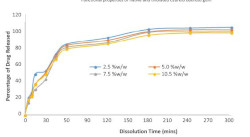
Results: COG and ThCOG contain alkaloids, cardenolides and saponins, but devoid of tannins and starch. COG and ThCOG were angular and irregular in shape respectively. ThCOG had a lower swelling index value (0.51±0.11%) compared to COG (1.63±0.03 %). Crushing strength was in the order: COG > ThCOG, while friability properties were in the reverse order. FTIR spectrum of ThCOG showed characteristic thiol peak (2558.7 cm-1 ), carbonyl stretching (1708.8 cm -1 ) and ester band (1279 cm-1 ), confirming thiolation, while retaining the basic structure. Drug release was slower in tablets containing ThCOG.
Conclusion: Thiolated Cedrela odorata gum showed improved mechanical, compressional and sustained release properties than the native gum, and has good potential when incorporated in sustained release formulations.
Résumé
Contexte : Les polymères naturels modifiés sont considérés comme des options appropriées pour les systèmes d'administration de médicaments à libération prolongée, en raison de leurs propriétés fonctionnelles améliorées.
Objectifs : Dans cette étude, la caractérisation à l'état solide et les propriétés fonctionnelles de la gomme de Cedrela odorata native et thiolée, en tant que composants de formulations de comprimés de comprimés d'ibuprofène, ont été étudiées.
Méthodes : Les composants phytochimiques de la gomme purifiée de Cedrela odorata (COG) ont été évalués avant sa modification par l'acide thioglycolique pour obtenir la ThCOG. Les poudres de COG et de ThCOG ont été caractérisées par des tests phytochimiques, la densité des particules, les propriétés d'écoulement, la morphologie, les indices de gonflement et la spectroscopie FTIR comme critères d'évaluation. Des formulations d'ibuprofène contenant différentes concentrations (2,5 % à 10 % p/p) de ces gommes et d'autres excipients ont été comprimées directement en comprimés. Leurs propriétés mécaniques ont été évaluées par des tests de friabilité et de résistance à l'écrasement, tandis que leurs propriétés de libération ont été évaluées par des tests de temps de désintégration et de vitesse de dissolution. Les résultats ont été analysés à l'aide de statistiques descriptives (n ± écart-type).
Résultats : La COG et la ThCOG contiennent des alcaloïdes, des cardénolides et des saponines, mais sont dépourvues de tanins et d'amidon. La COG et la ThCOG présentaient respectivement une forme angulaire et irrégulière. La ThCOG présentait un indice de gonflement plus faible (0,51±0,11 %) par rapport à la COG (1,63±0,03 %). La résistance à l'écrasement suivait l'ordre : COG > ThCOG, tandis que les propriétés de friabilité suivaient l'ordre inverse. Le spectre FTIR de la ThCOG présentait un pic caractéristique de thiol (2 558,7 cm -1 ), un étirement de carbonyle (1 708,8 cm -1 ) et une bande ester cm -1), confirmant la thiolation, tout en préservant la structure de base. La libération du principe actif était plus lente dans les comprimés contenant de la ThCOG.
Conclusion : La gomme thiolée de Cedrela odorata a montré des propriétés mécaniques, de compression et de libération prolongée améliorées par rapport à la gomme native, et présente un bon potentiel lorsqu'elle est incorporée dans des formulations à libération prolongée.
Downloads
Article Details
Issue
Section

This work is licensed under a Creative Commons Attribution-NonCommercial-NoDerivatives 4.0 International License.
How to Cite
Share
References
1.Nammas M (2025). The Impact of Drug Delivery Systems on Pharmacokinetics and Drug-Drug Interactions in Neuropsychiatric Treatment. Cureus 8 (17):1-6.
2.Ezike TC, Okpala US, Onoja UL, Nwike CP, Ezeako EC, Okpara OJ, Okoroafor CC, Eze SC, Kalu OL, Odoh EC, Nwadike UG, Ogbodo JO, Umeh BU, Ossai EC, Nwanguma BC (2023). Advances in drug delivery systems, challenges and future directions. Heliyon 24 (9): 6-12.
3.Shaikh R, Singh TRR, Garland MJ, Woolfson AD. Donnelly RF (2011). Mucoadhesive drug delivery systems. Journal of Pharmacy and Biological Sciences 3(1): 89 - 100.
4. Lele BS, Hoffman AS (2000). Mucoadhesive drug carriers based on complexes of poly(acrylic acid) and PEGylated drugs having hydrolysable PEG- anhydride-drug linkages. Journal of Controlled Release 69 (2): 237-248.
5.Jain S, Jain A, Jain R, Chauhan NS (2024). Potential of natural polymeric materials in pharmaceutics. Pharmacological Research - Natural Products 2: 1-14.
6. Puri V, Sharma A, Kumar P, Singh I (2020). Thiolation of biopolymers for developing drug delivery systems with enhanced mechanical and mucoadhesiveproperties: a review. Polymers 12(8): 18-30.
7. Rana V, Kamboj S, Sharma R, Singh K (2015). Modification of gums: synthesis techniques and pharmaceutical benefits. In: VK Thakur, MK Thakur, eds: Handbook of Polymers for Pharmaceutical Technologies: Scrivener Publishing. Pp. 229 - 364.
8. Dudhat KR (2020). The overview of oral solid dosage and different excipients used for solid dosage form formulations. Global Academic Journal of Pharmacy and Drug Research 4(3): 66 -72.
9. Ayorinde JO, Odeniyi MA (2018). Solid state characterization of two novel gums from Cedrela odorata and Enterlobium cyclocarpum. Journal of Pharmaceutical Investigation 48(4): 487-496.
10. Smrčka D, Ramesh S, Dumicic A, Beránek J (2026): Optimizing ibuprofen dosing: insights from in vivo and virtual pharmacokinetic trials. European Journal of Pharmaceutical Sciences 220: 928-987.
11. Tiranakwit T, Puangpun W, Tamprasit K, Wichai N, Siriamornpun S, Srisongkram T, Weerapreeyakul N (2023). Phytochemical Screening on Phenolic, Flavonoid Contents, and Antioxidant Activities of Six Indigenous Plants Used in Traditional Thai Medicine. International Journal of Molecular Science 24(17):13-23.
12. Gupta S, Trupesh R, Himanshu P, Hitesh S (2025). Comparative analysis of the phytochemical profiles of selected edible gums. International Journal of Molecular Science 2(4): 217-224.
13. Wakte P, Bhusari SS, Pradhan S, Shinganapure SS (2025). Comparative analysis of natural versus synthetic polymers in mucoadhesive buccal drug delivery systems: A focus on xyloglucan-based platforms. International Journal of Modern Pharmaceutical Research 11: 33-39.
14. Shen N, Wang T, Gan Q, Liu S, Wang L, Jin B (2022). Plant flavonoids: Classification, distribution, biosynthesis, and antioxidant activity. Food Chemistry 18:323-353.
15. Rüther M, Klippstein SH, Ponusamy SK, Rüther T, Schmid H (2023). Flowability of polymer powders at elevated temperatures for additive manufacturing, Powder Technology 422: 2023-2037.
16. Bondi G, D'Abbrunzo I, Hasa D, Parolin C, Vitali B, Bertoni S, Imbriano A, Pagano C, Fratini C, Sabbatini B. Bigucci F, Abruzzo A (2025). Innovative bilayered buccal films: A paediatric-friendly dosage form for transmucosal azithromycin delivery. International Journal of Pharmacy 684:126-164.
17. Suhag R, Kellil A, Razem M (2024). Factors influencing food powder flowability. Powders 3(1): 65-76.
18. Ghasemi MZ, Hellstrom JGI, Umeki K (2025). Effect of particle irregularity and particle size distribution on the morphology of packed beds of biochar particles. Scientific Reports 201 (2):101-128.
19. Adetunji OA, Ajakore, OM, Itiola OA (2021). Physicochemical and Morphological Properties of Thermally Modulated Carboxymethylated Entandophragma angolense Gum. European Journal of Pharmaceutical and Medical Research 8: 96-103.
20. Maslii Y, Ruban O, Kasparaviciene G, Kalveniene Z, Materiienko A, Ivanauskas L, Mazurkeviciute A, Kopustinskiene DM, Bernatoniene J. (2020). The Influence of pH Values on the Rheological, Textural and Release Properties of Carbomer Polacril® 40P- Based Dental Gel Formulation with Plant- erived and Synthetic Active Components. Molecules 25(21):50-68.
21. Gong Y, Chen X, Wu W (2024). Application of fourier transform infrared (FTIR) spectroscopy in sample preparation: Material characterization and mechanism investigation. Advances in Sample Preparation 11:100-122.
22. Monfared ZG, Hellström JGI, Umeki K. (2025). Effect of particle irregularity and particle size distribution on the morphology of packed beds of biochar particles. Scientific Report 29:15-20.
23. British Pharmacopoeia Vol. 1 and 2. British Pharmaceutical Press, Her Majesty's Stationary Office, London, 2010.
24. Singh Roy P, Biswas A, Pratihar S, Ghosh, AK (2025). Effect of binders on tablet hardness and disintegration time. International Journal of Pharmaceutical Research and Applications 10: 1612-1620.
25. Kayode AD, Adetunji OA (2024). Compression and release properties of two-step modified rice starch and lactose blends in paracetamol tablet formulations. African Journal of Biomedical Research 27: 343-348.
26. Puri V, Sharma A, Kumar P, Singh I, Huanbutta K (2021). Synthesis and Characterization of Thiolated Gum Ghatti as a Novel Excipient: Development of Compression-Coated Mucoadhesive Tablets of Domperidone. ACS Omega 10(24):15844-15854.
27. Kumar NR, Koteswara R, Vijaya Ratna J, Ramana-Murthy, KV (2024). Exploring the potential of neem and tamarind gum as release retardants: Design and statistical optimization of vildagliptin extended- release matrix systems using D-optimal quadratic mixture design. International Journal of Biological Macromolecules 259: 129-136.